


Carlo Ferdenzi - A Son of Vernasca in the Shadow of the Arandora Star
There is a small hamlet called Alessandroni, in the municipality of Vernasca, perched on the last folds of the Val d'Arda before the hills give way to the vineyards and gullies of the Piacenza area. From there, on June 12, 1897, Carlo Francesco Pietro Ferdenzi was born, the third of seven children in a farming family. He would never have imagined that his life—begun among the clay farms of the Apennines—would end in the middle of the Atlantic, in the cold of the ocean, victim of a German submarine and a war he had not chosen.
1897 · The Roots: Alessandroni and the Ferdenzi Family
Name: Carlo Francesco Pietro Ferdenzi
Born on: June 12, 1897 · Vernasca (PC)
Father: Pietro Ferdenzi, farmer, 41 years old
Mother: Celesta Negrotti, farmer, 30 years old
Family residence: Alessandroni locality, a rural hamlet in the municipality of Vernasca
Birth order: third of seven children
Pietro and Celesta lived like the vast majority of hillside families at the time: a life shaped by the rhythms of the land, wheat and fodder harvests, and the management of a farm they likely did not own. Alessandroni was—and still is—a small cluster of scattered houses looking out over the Val d'Arda from a ridge, far from population centers, far from everything.
Growing up there at the turn of the twentieth century meant inheriting not just a surname, but a destiny of hard labor. Large families were the norm: more children meant more hands for the fields, but also more mouths to feed on plots of land that inheritance patterns fragmented generation after generation, until they became too small to support anyone.
1915–1927 · The Great Flight from the Hills: Hardship, War, and the Draft
The decision to emigrate never stems from a single cause. For the young men of the Trebbia, Nure, and Arda valleys—including those of Vernasca, Morfasso, and Bettola—leaving for London in the early decades of the twentieth century was the result of pressure built up on multiple fronts, which broke out with particular force in the years immediately before and after the First World War.
“The land was no longer enough. It was not enough to feed a family, not enough to justify staying. And for many, it was not even enough to justify dying at the front.”
The causes were both structural and immediate. The crisis of subsistence agriculture had plagued these areas for decades: small properties, already fragile, were divided further with every generational transition. But making the situation unbearable was also the devastating drought of 1921–1922, one of the century's most severe weather events for Northern Italy: in the Piacenza region, rainfall deficits exceeded 70% compared to the average, local streams—including the Arda itself—dried up, and seasonal crops were lost. During the same period, late frosts in the mid-1920s repeatedly destroyed orchard blossoms and the first vine shoots, striking what had remained the only source of cash income for hill farmers.
Compounding this were the war years: the harsh winters between 1916 and 1917, with male labor taken from the fields and sent to the front, created acute poverty. The return of veterans from the conflict, far from bringing relief, worsened unemployment in a macroeconomic environment marked by inflation and instability.
Yet there was another factor—less documented, more hushed—that drove many young men from the Apennines to disappear before the state could find them: draft evasion. Military service was perceived as an alien, often lethal imposition in the name of a nation that had given little to peasant families. Leaving for London during the months when one was supposed to report to the barracks was a quiet way out practiced by many, disappearing into migratory flows before military authorities could log their absence. And when in the 1920s the Fascist regime began obstructing official emigration—deemed damaging to the nation's image—many left anyway through informal networks of village solidarity, responding to call-letters from fellow villagers already settled in London.
The destination was almost always the same. People from Piacenza and Parma had found a very specific professional niche in London: the catering industry. From the bottom of the ladder—as kitchen porters, scullery hands, and dishwashers in the large hotels of Soho and Holborn—they worked their way up to become waiters, cooks, and eventually, for the most enterprising, owners of small cafés, milk bars, and tea rooms. It was an established chain migration: those who arrived brought along relatives and fellow villagers, who then brought others.
1927 · London: The Lisson Grove Café and the Wedding with Celestina
We do not know with certainty when Carlo Ferdenzi left Vernasca. What we do know is that by 1927 he was already settled in London, integrated into that network of Piacenza emigrants that enlivened Marylebone and surrounding areas. But military records add a detail that changes the perspective on his departure.
Name: Carlo Francesco Pietro Ferdenzi
Draft Number: 7084
Personal file: not found
Comparison: the military files of two brothers are regularly present in the archives
Documented hypothesis: draft evasion, likely coinciding with emigration to England.
Carlo's name appears on the draft rolls for those born in 1897 under draft number 7084: he was regularly registered on the draft lists. But no military file exists in his name. The comparison with his brothers is illuminating: two of them have their files preserved in the archives, ruling out an accidental loss of records. The explanation most consistent with the facts is that Carlo was a draft evader—that when called to arms, he simply did not show up.
This was far from an isolated choice among young men from the Piacenza Apennines. Many emigrated in the exact months when they were supposed to appear before the draft board, vanishing into migratory streams before authorities could track them. Carlo's departure for London may therefore have been not just a response to agricultural poverty, but also—or above all—an escape from a war that hill peasants did not feel was theirs. Not necessarily cowardice: it was often a rational, quiet, and widespread choice by those who saw no reason to die on the Karst for a state that had done little for them.
If this interpretation is correct, Carlo left Italy carrying with him an irregular legal status: that of a draft evader, wanted under Italian military law. A condition that made returning home difficult, if not impossible. London was not just his destination: it had become his only chance for a future.
Groom: Carlo Ferdenzi – shopkeeper / proprietor
Bride: Celestina Maria Virginia Bragoli, 19 years old
Born on: July 17, 1908 in Vernasca
Father of the bride: Angelo Bragoli
Mother of the bride: Maria Sorenti
Note: in civil status registers the bride appears as “Celestina”; on the marriage certificate her full name is Celestina Maria Virginia.
Celestina Bragoli was only nineteen years old. She too was born in Vernasca, in 1908—eleven years after Carlo. They were likely long-time fellow villagers, or perhaps met in London within that emigrant community that replicated village bonds thousands of miles from home. The wedding took place at St. Giles Church in London, in the dead of winter.
On the marriage certificate, Carlo declares his profession as esercente: the Italian term for someone managing a commercial business, almost certainly a catering establishment. British archives confirm this reading through a series of court records that, paradoxically, offer the most vivid portrait of his London life.
Carlo Ferdenzi, proprietor of a catering establishment at 80 Lisson Grove, is fined 30 shillings for permitting gaming via a reel slot machine on his premises on January 23, 1933.
Carlo Ferdenzi is summoned again before the same court for the same infraction. Inspector France reveals that this was already his fourth fine in a few months.
A third proceeding. Carlo states he kept the machine to attract customers, but admits he may have to “sell out or close down at any moment.”
These three newspaper articles, dry and bureaucratic like all court reporting, say far more than it seems. Lisson Grove is a street in Marylebone, at the heart of the neighborhood that housed most of London's small Italian shopkeepers. Slot machines—so-called fruit machines—were a very common tool for attracting customers to neighborhood cafés during the Great Depression. The repeated fines tell the story of a man holding on, trying to keep his business open despite the economic hardships of those years. The 1935 statement—“sell out or close down at any moment”—is a flash of reality: the depression was closing in, just as it was for all small immigrant business owners in those years.
June 1940 · “Collar the lot”: London's Italians Become Enemies
On June 10, 1940, Mussolini's Fascist Italy declared war on Great Britain. In the hours immediately following, Winston Churchill issued a mandatory order to British security services: “Collar the lot.” With those three words, thousands of Italian and German men who had lived peacefully in the United Kingdom for years—sometimes decades—suddenly became enemy aliens.
It was a mass roundup, indiscriminate and chaotic. Prisons and temporary internment camps filled up in a matter of days. The British government feared a fifth column, spies and saboteurs hidden among immigrants, ready to facilitate a Nazi-Fascist invasion. In reality, the vast majority of those arrested were exactly what they seemed: artisans, restaurateurs, ice cream makers, shopkeepers. Men who had chosen Great Britain as their second home and had no operational ties to the regime in Rome.
Carlo Ferdenzi was arrested alongside them. His internment card is cataloged today under series HO 396/163 at the British National Archives. He was forty-three years old.
people aboard the Arandora Star
victims of the sinking
Italians lost, mostly from the Piacenza-Parma Apennines
July 2, 1940 · The Arandora Star: The Nameless Ship That Could Not Be Saved
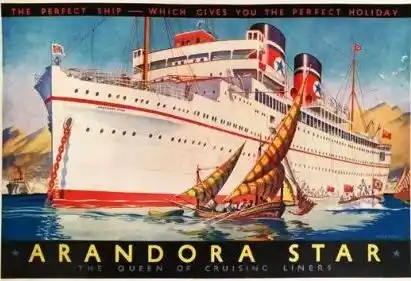
Until shortly before, the SS Arandora Star had been one of the most elegant luxury liners in the Mediterranean: white, with red funnels and mahogany-floored cabins. War had transformed her into a troop transport: painted gray, stripped of furnishings, carrying not wealthy tourists but civilian prisoners.
She set sail from Liverpool on June 30, 1940, bound for an internment camp in Canada. On board: over 1,500 people—Italians, Germans, Austrians. Among the Germans and Austrians were many Jewish refugees and anti-Nazi dissidents, paradoxically classified as “enemies” by the British government solely by virtue of their passports. Among the Italians, the majority were men from the Piacenza and Parma valleys.
The ship sailed with dimmed lights. She bore no humanitarian insignia and had no recognizable military escort. In the eyes of an enemy submarine, she was a legitimate target.
“The German submarine U-47 intercepted her off the Irish coast during the night between July 1 and July 2, 1940. A torpedo struck. The Arandora Star sank in less than an hour.”
Of the roughly 800 people who perished, 446 were Italian. The vast majority came from the Tuscan-Emilian Apennines: people from Bardi, Borgotaro, Morfasso, Vernasca. People who knew the same roads, the same surnames, the same scents of woods and clay as Carlo Ferdenzi.
Carlo did not return. No documents attest to the recovery of his body. As for hundreds of others, the Atlantic became his grave.
1940–2003 · Celestina: A Story That Continues Across the Ocean
Celestina Bragoli was thirty-two years old when she became a widow. We do not know how she learned the news, nor how she navigated the war years in London. We know that she stayed. And then, that she rebuilt a life.
Ferdenzi Giuseppe, 41 years old – café proprietor
Ferdenzi Celestina – wife (spouse of Giuseppe)
London residence: 98 Lisson Grove, Marylebone, N.W.1
Accompanying children: Lina (12), Inez (16), Carlo (11 months)
US Destination: 32 Thompson St., New York 13, N.Y.
Source: Passenger and Crew Lists of Vessels Arriving at New York, 1897–1957 – National Archives Microfilm Publication T715, roll 7875; Records of the Immigration and Naturalization Service, Record Group 85.
What Remains: A Name, an Address, a Torpedo
Carlo Ferdenzi's story is, in its essential traits, the story of hundreds of men from the Val d'Arda and neighboring valleys. Leaving with neither formal education nor capital, armed only with the tenacity of those raised on harsh terrain. Patient builders of small things—a café, a marriage, a London routine—that war swept away in a single July morning.
The tragedy of the Arandora Star was not merely a military tragedy. It was the point of convergence for three cruel ironies: men who fled poverty killed by the government hosting them; victims of a German submarine fighting against the Fascist regime in whose name they had been interned; emigrants who had chosen Great Britain as their second home and were treated as enemies for it.
What the story of Carlo and Celestina leaves us—beyond documents, newspaper clippings, and passenger manifests—is an insight into the deep structures of Italian emigration: networks of village solidarity (two Ferdenzis from Vernasca reuniting in London, then moving on to America), the transmission of trades (both brothers running cafés in Marylebone), and family continuity even through disruption (the second marriage to her husband's brother, the child named Carlo). Celestina passed away at ninety-five in New York, taking with her nearly a century of history that began on a hillside in Piacenza.
Source Notes
The reconstruction of this story is based on primary archival documents integrated with historical sources on the Italian community in London and the tragedy of the Arandora Star.
— Birth certificate: Municipality of Vernasca, Register of Births, 1897.
— Draft rolls, class of 1897: Military District of Piacenza – roll no. 7084 (Carlo Francesco Pietro Ferdenzi); personal file absent; brothers' files present. Hypothesis: draft evasion.
— Marriage certificate: St. Giles, London, December 8, 1927.
— Internment record: The National Archives (UK), series HO 396/163.
— Court news reports: St. Marylebone and Paddington Record, February 25, 1933; May 20, 1933; May 11, 1935.
— Second marriage record: St Marylebone, London, Volume 5D, Page 802 (1948).
— Passenger manifest SS Britannic: Board of Trade, BT27/3224, Series BT27, ticket 258283.
— Ellis Island / New York Passenger Lists: National Archives Microfilm Publication T715, roll 7875; Record Group 85.
— Historical context: Piacenza Emigration to London in the 19th–20th Centuries; archives of the Italian community in the United Kingdom; documentation on the sinking of the Arandora Star (July 2, 1940).